


The Inner Tea Party
- 2 days ago
- 3 min read
The Inner Tea Party
This post is from our friend Lindsey V. of the New York Center.
The aim of 'myths' and 'symbols' was to reach man's higher centers, to transmit to him ideas inaccessible to the intellect." — G.I. Gurdjieff
Fairy Tales can often point out deeper Truths. Lewis Carroll’s Alice’s Adventures in Wonderland is one such tale. Early on in her adventures, Alice comes across a hidden door to which she is given a key. In Wonderland, with its unfamiliar inhabitants, she discovers that familiar things no longer seem so familiar. In “The Pool of Tears,” after repeatedly changing size, she becomes confused about her identity:
“But if I’m not the same, the next question is, Who in the world am I? Ah, THAT’S the great puzzle!”
Alice’s question is the essential question in all spiritual work, Who are we? The Fourth Way teaches that we do not know who we are because we mistakenly assume that we are unified. Gurdjieff says, “Man has no permanent and unchangeable I.” Instead, “every thought, every mood, every desire, every sensation, says ‘I.’” There are “hundreds and thousands of separate small ‘I’s,” often unknown or opposed to one another.
These ‘I’s are not simply different moods or aspects of a unified personality. Each small ‘I’ can temporarily take possession of the entire machine and speak in the name of the whole, making decisions and promises with which another ‘I’ – or, in my case, Lindsey– will have to deal with. We can easily see this in our daily lives. One ‘I’ sets the alarm clock early intending to exercise before work; another ‘I’ hits the snooze button the next morning. One ‘I’ decides to stop drinking alcohol; another orders a glass of wine. One sincerely decides to commit to using the exercise of the week, then realizes one week later that we “lost’ the ‘I’ to work with the exercise. The amazing thing is that we seldom notice this. We mostly live in the ‘I’ of the moment.
Why, then, do we experience ourselves as one? Part of the illusion comes from the continuity of the physical body, our name and memories. Language helps conceal the changing multiplicity of the ‘I’s: I am happy, I am sad, I became angry. The repeated word ‘I’ joins different moments together and creates the illusion of unity. What Gurdjieff called buffers prevents us from experiencing the shock of our own contradictions. We can think ourselves honest while exaggerating, energetic while repeatedly avoiding difficulty, or committed to spiritual work while continually forgetting it. With buffers the contradiction is softened, explained away, or simply forgotten. Without buffers we would see how little inner unity we actually possess.
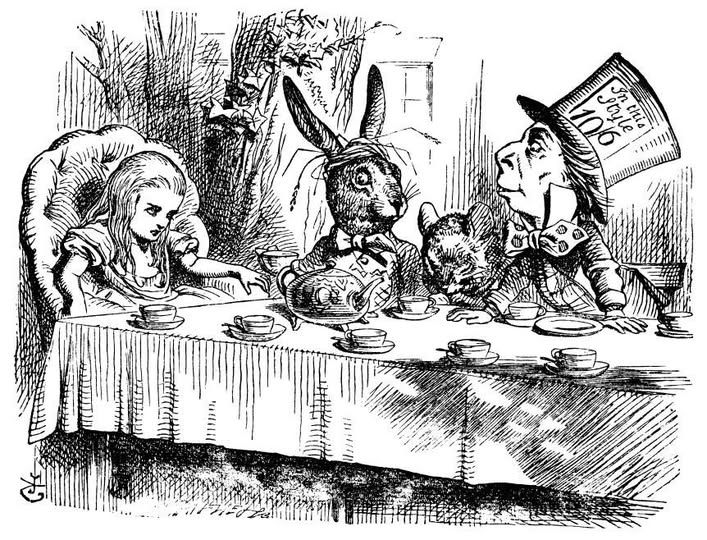
The Mad Hatter’s Tea Party in Wonderland provides an apt image of this inner world. Alice comes upon a strange tea party attended by the Mad Hatter, the March Hare, and a sleepy Dormouse. Time has stopped at six o’clock because the Hatter has quarreled with time, so it is always teatime. At the Mad Hatter’s tea party, the Hatter, March Hare, and Dormouse interrupt one another, change subjects, contradict themselves, and continually change places. The Dormouse drifts in and out of sleep. Everyone speaks, but no one is really in charge. They move around the table without going anywhere. Our inner life can be much the same: different ‘I’s continually take the best seat and behave as though each owns the house.
In schools the alarm clock is always set on Now. — The Teacher
In Wonderland Alice begins to question her apparent continuity: “I wonder if I’ve been changed in the night?” and “Was I the same when I got up this morning?” We can see the parallel. Who was angry this morning? Who is happy now? Which ‘I’ wants to awaken, and which one would rather remain comfortable?
So fierce is the vehement struggle for unity within oneself. — Walt Whitman
This is where self-observation becomes essential. When an angry ‘I’ appears, instead of automatically saying I am angry, we begin to recognize anger is present; an angry ‘I’ has appeared. Understanding that what we usually call ‘I’ is not real ‘I’, the angry ‘I’ will shortly be replaced by another ‘I’. This separation weakens identification and creates room for self-remembering.
The aim is not to be the nicest character at our inner tea party and call that the real ‘I.’ Nor is it to eliminate the many ‘I’s. It is to see them clearly without identification. This seeing brings the lower centers into greater balance and harmony, allowing us to experience more presence in our lives.
Our lives are an opportunity to make the teaching our own. — The Teacher
The Mad Hatter's Tea Party, Illustration by John Tenniel


Comments