


EAR TO HEAR
EAR TO HEAR
Listening with presence to our friends, family, employers, and so on, in fact anyone and everyone who crosses our path, and especially for a Fourth Way student, is a given. Listening with presence must also have been a key facet of the Buddhist teaching, because many representations of the Buddha are rendered with oversized ears, as if to emphasize this practice. And not only the Buddhist tradition taught the practice of consciously listening. Epictetus famously stated, “We have two ears and one mouth to listen twice as much as we speak.” Indeed, if we look at the word ‘Ear’ and add the eighth letter of the alphabet to the beginning of this word, we are directly informed of the function that this part of our anatomy employs.
There is also another listening that is less obvious. The expression, ‘He who has ears to hear let him hear.’, and variations thereof, occurs throughout New Testament. It may be a surprise - or not - to hear that the Bible was written by schools for schools, and that the above phrase ‘He who has ears to hear….’ has a particular meaning for anyone engaged in the evolution of consciousness at any level.
In the forward of his book Psychology of Man’s Possible Evolution Peter Ouspensky writes, "I found that the chief difficulty for most people was to realize that they had heard new things. It is not easy to realize that one is hearing new things. And when we hear new things, we take them for old, or think that they can be explained and interpreted by the old." He continues, "I cannot guarantee that you will hear new ideas, that is, ideas you never heard before, but if you are patient you will very soon begin to notice them. And then I wish you not to miss them, and to try not to interpret them in the old way.”
Schools use particular words and phrases that are called ‘work language’. There are many words in work language that are familiar to us but in schools, have specific meanings. As students mature, they become familiar with this work language, in fact, familiar to the point that the words they hear day-after-day, month-after-month, year-after-year, enters their being and becomes an internal compass as it were, always pointing towards inconspicuous wordless presence.
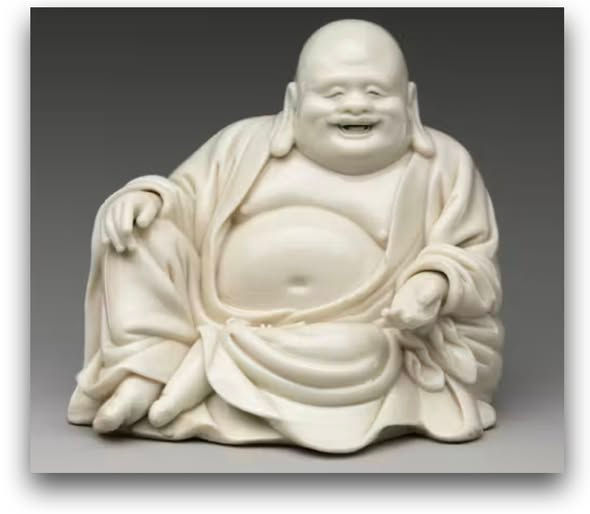
And now we can perhaps offer an inner, or esoteric meaning of the image of the Laughing Buddha. Using the colloquial expression ‘fat and happy’, what we see portrayed is a cheerful steward, utterly replete with the knowledge he hears and synthesizes, allows him to prevent the four lower centers from impinging upon and usurping the third state. His ears seem oversized, but they are in fact, exactly the correct size to hear the ‘glad tidings’ of self-remembering that the innermost chamber of the heart silently invokes.
And because esoteric art contains many meanings that both points to, and creates the divine state of presence, the Laughing Buddha is also a symbol for the Work I ‘HEAR’; the single-syllable imperative from the steward, that dispels the noise of imagination and identification, thereby allowing inconspicuous wordless presence to cheerfully flourish.
Laughing Buddha, China, 17th-18th century
Metropolitan Museum of Art, New York


Comments