


A Key to Four-part Harmony
A Key to Four-part Harmony
In the Fourth Way, the lower functions of the human organism are divided into four lower centers or brains, two of which we share with the animal world and two distinctively human. (G.I. Gurdjieff merged two functions into one center which we share with other living organisms: the moving and instinctive centers.) The other two functions not developed in animals are the intellectual center and the emotional center, although some animals may have a rudimentary emotional center.
The value of knowing about these distinctly different centers is to understand myself as a four-brained being which needs to be unified through efforts to self-remember, eventually accessing higher states of consciousness and higher centers. When each brain is performing its proper function without interfering with the others then this control of centers can generate energy which can be used toward higher states of consciousness. When wrong work of centers interferes, I am imbalanced, ununified and I lose the intensity of energy required for higher consciousness and awakening.
The moving and instinctive centers govern the body's physical actions and internal biological functions. An example of the instinctive and moving centers creating wrong work is when I am practicing on a particularly difficult piece of music, my body might produce unnecessary muscular tension in my shoulders or habitually move in a way counter to the patterns that are required to master the piece. Intentionally relaxing my shoulders and reflexes and controlling my moving center begins with self-observation to identify "leaks" of energy. With continued self-observation and awareness, I am able to learn to play with the optimal amount of tension and energy required for the task at hand and use the excess energy to heighten my state. I recently learned a firehouse motto which illustrates a balanced and intentional approach to learning music with the moving center: “Slow is steady and steady is fast.”
Continuing with the analogy of learning music, after technical mastery the emotional center can interfere and become overwhelmed with emotion during a performance, or my instinctive center can be so tense and uncomfortable in front of an audience that I lose control of the moving center’s technical mastery. This interference or wrong work of centers causes leaks of energy, an energy which is necessary for self-remembering while performing. Keeping the centers balanced and in control during stressful situations is particularly challenging and self-remembering is a harbor in a storm.
Do not let your tongue outrun your thought. —Chilon
Wrong work of the emotional center is also easy to see and feel through the expression of negative emotions. The energy loss is obvious not only to the person expressing negativity but to those near the eye of the storm. It is a remarkable and exhilarating experience to harness the energy of a negative emotion by not expressing it and transforming it into a higher state. This experience continues to teach me the importance of the immense amount of energy required for sustaining higher states. To gain control, I need to observe, practice, and rehearse intentionally during calm moments. Self-awareness prepares me to stave off the identification which leads to negative emotions before negativity becomes all consuming. I can predict and move away from my mechanical reactions and choose to use the energy toward a more objective state.
Rodney Collin said that imagination is a waste product of the mind. Similarly, gesticulation is a waste product of the moving center. —The Teacher
Formatory thinking, mechanical internal chatter and unnecessary talk are wrong work of the intellectual center. By practicing divided attention—simultaneously being aware of my thoughts, speech, and my physical presence—the intellectual center is brought into harmony and does not lose energy otherwise released through sleep and wrong work. What I am trying to develop is a conscious ‘I’ – a steward – that can guide and balance the four centers so that they function in harmony and become more unified.
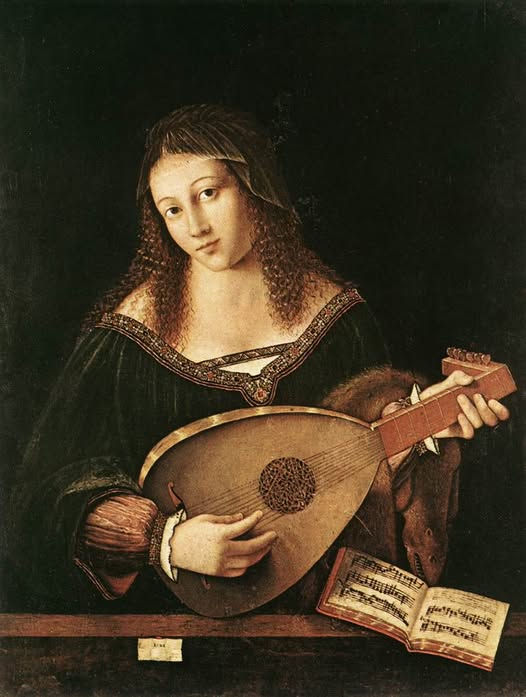
Woman Playing a Lute, Bartolommeo Veneto (1502-1555)


Comments